


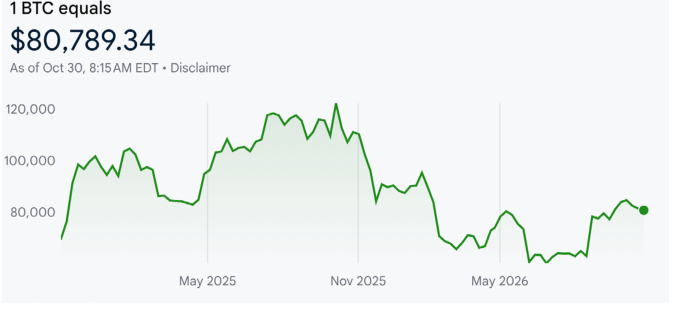
Bitcoin traders and coin holders are feeling a bit in the dumps lately, with the token’s price falling for five straight days. This is on top of a long slide that has taken the price from a high of $126,198 per coin in October of last year to just under $81,000 today—a 50% drop in roughly 12 months. But there are some token investors who are feeling a bit more pain than the rest: people who had parked their assets in Binance, the world’s largest cryptocurrency exchange.
Earlier this week, hackers managed to break into digital wallets at the exchange and ‘withdrew’ $6.3 billion worth of other peoples’ tokens in what is being described as the largest crypto heist ever. This is larger than the $1.5 billion Bybit hack last February, the $540 million Ronin network hack, and the theft of $530 million from Tokyo-based Coincheck.
If this lends the impression that cryptocurrency ‘assets’ are not quite as secure, more easily filched than ordinary investments like stocks and bonds, you’re almost certainly correct. The suspected hackers were an elite North Korean hacking unit—the same culprits allegedly involved in the Bybit theft. There’s actually more to the story than North Korea acquiring more assets in an hour than its total gross national product generates in a month and a half.
Binance was founded by Changpeng Zhao, who pled guilty to violating anti-money laundering laws in 2023 before he was pardoned by President Donald Trump in October of last year. He remains Binance’s largest shareholder. In the aftermath of the hack, Bitcoin prices dropped an estimated 2-3% on the exchange. Go figure.
Sparing the Punch Bowl
You might have read the breathtaking news that the U.S. Federal Reserve Board decided… to do nothing. Nothing, that is, in the way of raising the Fed Funds Rate. Economists with a sense of humor (there are reportedly at least two of them) have described a Fed rate rise as ‘taking away the punchbowl when the party starts to get out of hand’—the ‘party’ in this case being an economy that might be roaring out of control.
In the announcement that the Fed was going to allow the partygoers at least one more drink, there was some evidence that the party—that is, the economy, might indeed be drifting into excess.
Consider some of the Fed’s language: ‘economic activity is expanding at a strong pace… domestic spending has been resilient… Productivity growth is strong and capital investment is robust… job gains have kept pace with the workforce, and the unemployment rate has changed little… and most notably ‘inflation remains elevated.” Inflation is what you get when the party starts to get a little wild.
It’s well-known that the Fed’s target for the inflation rate is 2% a year—while the current inflation rate is 3.7% a year and appears to be rising in the general direction of twice the target rate and, if economic activity keeps expanding at a strong pace, potentially beyond. What’s wrong with an expanding economy? It’s good for prosperity, good for the markets, and keeps people employed.
The signal that might be faintly perceived through the noise is that the Fed economists might believe the party will end on its own—that, in fact, there may be danger of a recession on the horizon, and nobody in government wants to be blamed for triggering it. So let the good times roll. Nobody ever complains about the party going on too long—so long as things don’t get uncomfortably out of hand. For the time being, that doesn’t seem to be what our leading economists are most worried about.
And that, at some point, could cause quick-twitch traders to worry, and cause a glitch in the markets.
Mandatory Enrollment
Amid the tax cuts, and making other cuts permanent, the One Big Beautiful Bill Act gave Americans something called the Trump Account, otherwise known as a 530A account after the new revenue code that created it. Parents could open one of these accounts for any child (or grandchild) born in 2009 or later, and contribute $5,000 a year that would compound tax-free.
The account would be required to invest in a low-cost index ETF that would grow as the child grew until, at age 18, the account would become an IRA in the child’s name. At no time can the child, or parents, take distributions from the account, and the child would not be able to take money out of the IRA, without penalty, before turning age 59 1/2. Basically, the Trump Account is a retirement account for babies.
To create this account after the bill passed, all a parent had to do was file IRS Form 4547 or sign up through the official Trump Account (TrumpAccounts.gov) website. One might imagine how the government staffers waited breathlessly for millions of Americans to jam the website trying to get children enrolled so that 50 years later they could begin taking out some of the money for lifestyle and retirement expenses. But… let’s just tactfully say that a lot of families never got around to it.
So what does the government do with a manifestly unpopular program? It gives it to you anyway. As of September 30, the government formally enrolled every child who was born in 2009 or later, who also has a Social Security number—60 million in all—in their own Trump Account. Children born after December 31, 2024 and before January 1, 2029 also received $1,000 in seed money in the account. To sweeten the deal, Elon Musk has promised to donate a share of SpaceX stock to every claimed account.
In order for the account to become active, a parent or guardian must claim the automatically-created account in the child’s name. That means they have to prove who they are, show that they have legal authority over the child’s account, and sign some consent forms so the Treasury Department can share the child’s information with them. That gives them the right to sign the account agreement and start contributing. Is it legal for the government to open an account for your child without asking?
Apparently yes; and you have to admit it’s a … creative fix for the lack of demand for these accounts. It will be interesting to see how many parents decide to claim their children’s accounts (and that share of SpaceX), and perhaps even more interesting to see how many scammers get away with convincing parents to give away their kids’ Social Security numbers and maybe even their accounts over the confusion around the enrollment process.
But all that aside, if you want to invest money that your child will have available when he or she reaches retirement age, this is the opportunity for you.
A Smaller Piece of the Pie
We keep reading vague reports that American workers don’t feel like they’re keeping up with the robust economy, and that workers today (and especially tomorrow) are not able to experience the living standards that their parents did. But have you ever seen tangible evidence that this is true?
The latest report from the Bureau of Labor Statistics includes an eye-opening chart that maps, since 1947, the percentage of total ‘production’ (think corporate revenues) paid to the workers employed by corporations. In other words, how much do corporations and shareholders get to keep of the money they take in, vs. how much is paid out to the workers? The chart shows that from 1947 through 2005, the workers’ share of the pie ranged from 60% to 65%.
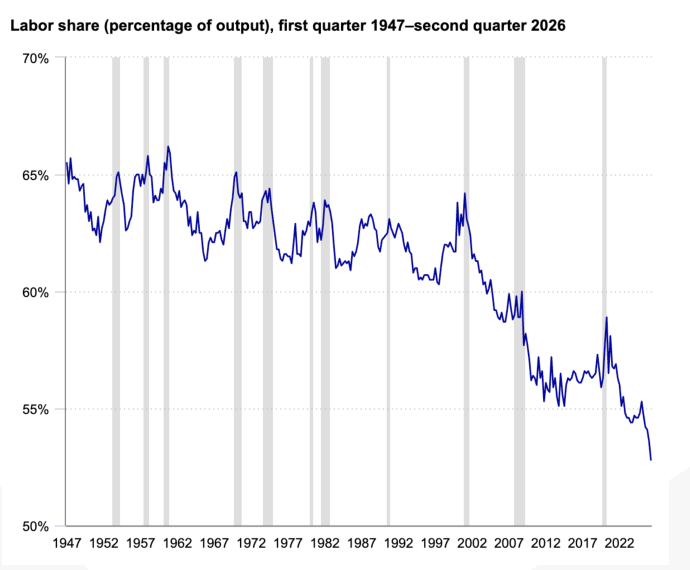
But, as you can see on the graph, that percentage has been in steep decline for the past 20 years, and now stands at roughly 47%—and is dropping like a stone. And, yes, the workers’ figure counts wages, salaries, benefits, pensions, and other earnings. This would seem to validate the idea that workers today are less well off than their parents, as more corporate work and industrial production becomes automated.
But the most eye-opening part of the graph is the last few years, where the workers’ share of the pie seems to be falling off a cliff. This period coincides with the advent of AI in the business ecology. Could there be a correlation?
Download a PDF version of this article below.